

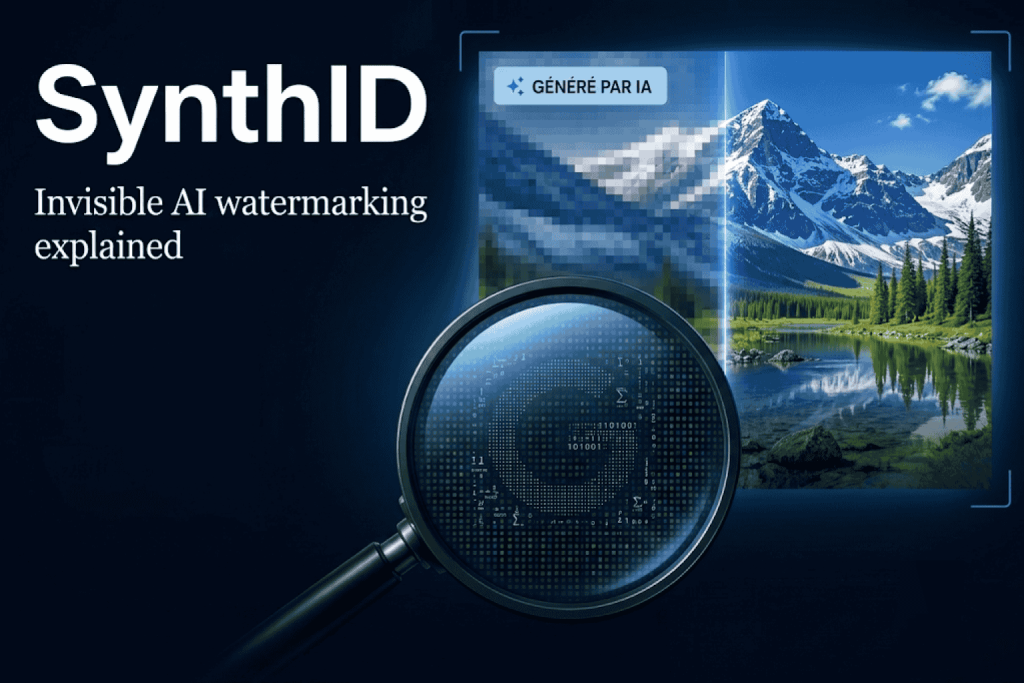
Google has opened its SynthID Detector to the public. Tribune (9 October 2026) reports that the web-based portal is now available in Nigeria, free of charge, to citizens, journalists and digital creators. It checks photos, videos and audio for an invisible watermark that some artificial intelligence (AI) tools add when they generate content.
Technext (8 October 2026) reports that Google announced the expansion on 7 October and that the tool is available globally in English. BusinessDay reports that Google DeepMind, Google's AI research arm, had earlier limited the detector to journalists, media professionals and researchers. For ordinary Nigerians, this means a free first check on a suspicious file that was not available to them before.
SynthID works by looking for a hidden mark placed in content at the moment an AI model creates it. Tribune says the watermarks are designed to stay detectable after cropping, resizing, re-colouring or heavy compression. Tribune adds that users can upload media directly or run checks through the Gemini app, Google's AI assistant.
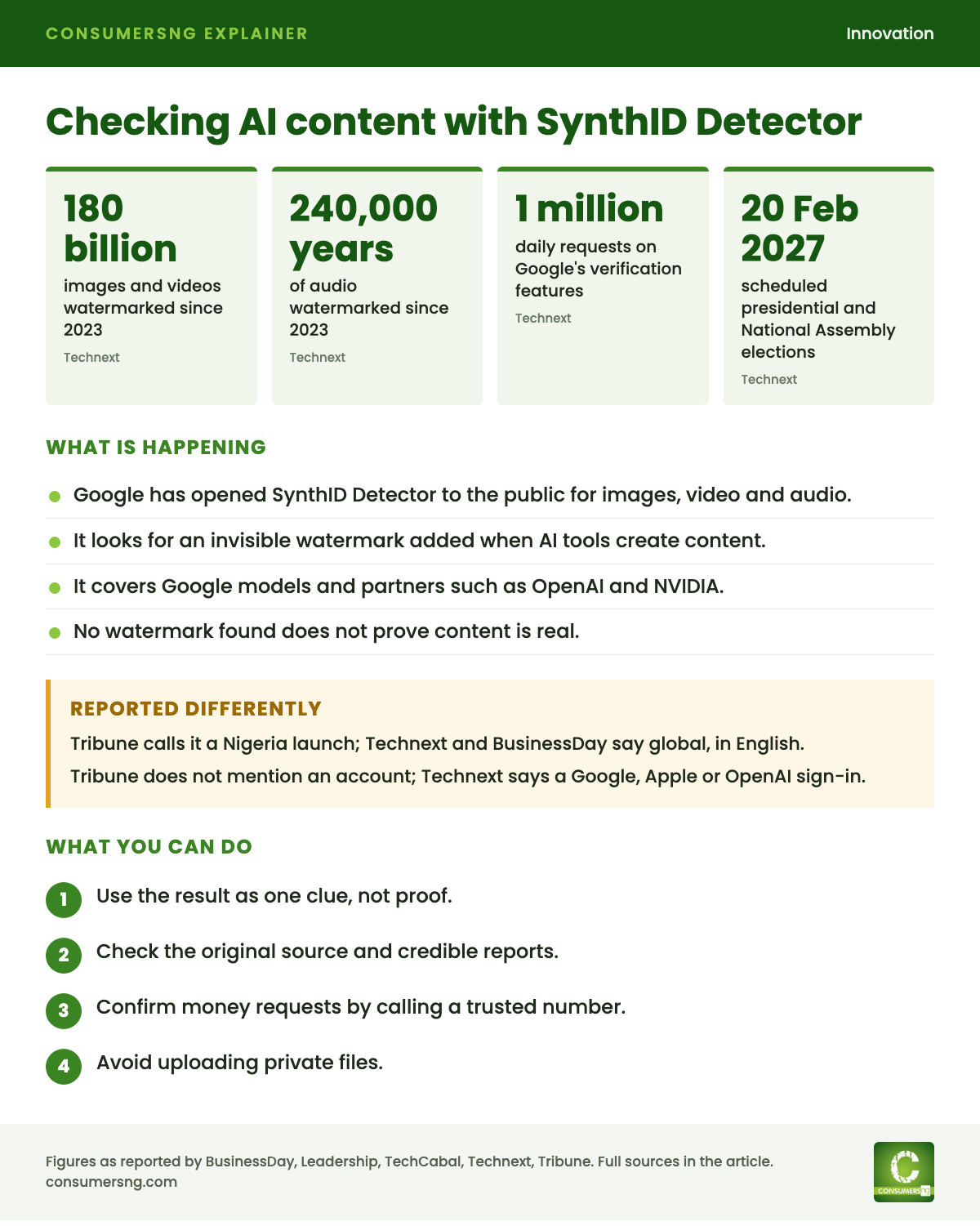
Google's own figures, as reported by Technext and BusinessDay, are that more than 180 billion images and videos and 240,000 years of audio have been watermarked since SynthID launched in 2023. Technext also reports that Google says its verification features in Search, the Gemini app and Chrome handle more than 1 million requests a day. These are company figures and have not been independently checked.
The launch comes as the Independent National Electoral Commission (INEC) warns about deepfakes, meaning realistic fake images, video or audio, ahead of the 2027 elections. Technext reports that the presidential and National Assembly elections are scheduled for 20 February 2027 and the governorship and State Assembly elections for 6 March 2027. Technext is the only outlet that ties the tool directly to the elections.
What the sources say
- Tribune: Reports that SynthID Detector is now open in Nigeria for free use by citizens, journalists and creators on photos, videos and audio. It says the tool detects content from Google's Imagen, Veo and Gemini models and identifies watermarking from partners including OpenAI and NVIDIA Corporation (NVIDIA).
- Tribune: Quotes Olumide Balogun, Google's Director for West Africa, saying preserving digital trust and transparency is paramount. Silas Jonathan, Lead AI and Digital Forensics Researcher at FactCheckAfrica, called the launch a pivotal milestone and free tools a vital line of defense. Tribune also says Google confirmed daily usage quotas for images, short videos and audio but gave no figures.
- Technext: Reports that Google announced the public expansion on 7 October, that the tool is available globally in English, and that partners include OpenAI, NVIDIA and Kakao, with Apple expected to join. It says Google's accompanying communication indicates sign-in with a Google, Apple or OpenAI account.
- Technext: Warns that SynthID is not a universal AI detector. Content from AI systems without a compatible watermark may not be flagged, and a no-result outcome does not prove something is human-made. It advises users to check the original source and credible reports as well.
- BusinessDay: Reports that Google DeepMind says the detector was previously limited to journalists, media professionals and researchers and is now available globally in English. It quotes Pushmeet Kohli, Vice President of Science and Strategic Initiatives at Google DeepMind, saying clear context about online content helps people make informed decisions about what to trust.
- TechCabal: In a 25 June 2026 explainer, reports that SynthID launched in August 2023 as a prototype on Imagen and that in May 2026 Google DeepMind and OpenAI announced a partnership so that images from ChatGPT, the DALL·E image generator (DALL·E), Codex and the OpenAI application programming interface (API) would carry the watermark.
- BusinessDay: Reports that INEC chairman Joash Amupitan, speaking at the 22nd All Nigeria Editors Conference in Enugu, urged editors to set up fact-checking desks, use forensic image-analysis tools and verify results through official INEC channels. He was represented by Enugu Resident Electoral Commissioner Chukwuemeka Chukwu.
- Leadership: Reports that Amupitan said INEC has created an AI division within its information and communication technology department, uses automated AI auditing tools in results verification under a five-pillar framework with mandatory human oversight, and is finalising an AI governance policy.
Where the sources agree
- Tribune, Technext and BusinessDay all report that Google has made SynthID Detector publicly available for images, video and audio, and that it is no longer limited to journalists and researchers.
- All the coverage describes the same mechanism: the tool looks for an invisible watermark added when content is generated, rather than judging whether an image looks fake.
- Tribune and Technext both name OpenAI and NVIDIA as partners whose watermarks the tool can read, and TechCabal supports the OpenAI partnership.
- Technext and BusinessDay give the same Google figures on watermarked content, and all three launch reports place the tool in the context of deepfakes and misinformation.
Where they differ
Is this a Nigeria launch or a global one?
- Tribune: Frames the release as Google opening access to Nigerians, with a quote from its West Africa director.
- Technext: Says Google announced a worldwide release and that the tool is available globally in English, with no Nigeria-specific feature described.
- BusinessDay: Also says the detector is available globally in English.
Do you need an account, and how do you access it?
- Tribune: Says users can upload media directly or check through the Gemini app, and does not mention an account.
- Technext: Says Google's blog does not state an account requirement, but that Google's accompanying communication says users can sign in with a Google, Apple or OpenAI account.
How much to rely on the tool
- Tribune: Presents the tool as a vital line of defense, quoting FactCheckAfrica's Silas Jonathan, and says the watermarks are designed to survive edits. It gives no failure or accuracy figures.
- Technext: Stresses that it is not a universal AI detector and that a no-result outcome proves nothing about authenticity.
What the authorities say
No Nigerian regulator has been reported commenting on the tool. The coverage carries no statement about it from the National Information Technology Development Agency (NITDA), the Nigerian Communications Commission (NCC) or the Federal Competition and Consumer Protection Commission (FCCPC). The position on record comes from Google itself: Olumide Balogun, Director for West Africa, says the company is placing advanced verification technology in the hands of everyday users, newsrooms and researchers, and Pushmeet Kohli of Google DeepMind stresses giving people context about what they see online. These are company statements, not regulatory findings. INEC has separately warned about deepfakes, voice cloning and fake result sheets, and has told editors to verify results only through official INEC channels. None of the reports says INEC has endorsed or mentioned SynthID Detector.
What this means for you
You can now run a free first check on a suspicious image, video or audio clip, such as a viral political photo, a celebrity endorsement or a voice note that sounds like a relative asking for money. Tribune and Technext both report that the tool is open to the public.
If the tool finds a SynthID watermark, that suggests the file was made or altered with a participating AI tool. That is a reasonable reading of how watermarking works, but it does not tell you whether the claim attached to the file is true or harmless.
If the tool finds nothing, that does not mean the content is genuine. Technext says AI systems without a compatible watermark may go undetected, so a fake made with another tool could still pass.
Creators, musicians and public figures may benefit. Tribune says unnamed civil society and tech stakeholders expect the tool to help protect them from AI cloning and copyright infringement, though no examples are given.
Scammers use fake images, cloned voices and fabricated videos to build trust. A watermark check can add one more safeguard, but it cannot replace calling the person back or confirming through an official channel.
Daily limits apply. Tribune says Google has set usage quotas for images, short videos and audio but gave no numbers, so heavy users such as newsrooms may need to plan around them.
What you can do
- Treat a SynthID result as one clue, not a verdict. A watermark found suggests AI involvement; no watermark found proves nothing.
- Check the original source: who first posted the image, video or audio, and whether credible outlets or fact-checkers report the same thing.
- Before sending money on the strength of a video call, voice note or photo, confirm by phone using a number you already trust.
- For election information, rely on official INEC channels for results and announcements, as INEC has advised.
- Be careful what you upload. Google's terms for uploaded files are not described in the coverage, so avoid uploading private or sensitive images and read the privacy terms first.
- Do not forward a suspicious clip before checking it. Spreading a fake can harm others even if you did not make it.
ConsumersNG is a consumer research platform, not a financial adviser, lawyer or medical professional. These steps are general information to help you ask the right questions. Before making decisions about your money, health or legal rights, check with the relevant regulator or a qualified professional. Read our full Disclaimer.
Still unclear
- How accurate is the detector? No outlet reports accuracy, false-positive or false-negative rates, or tests of how well the watermark survives deliberate attempts to remove it. Tribune's claim is a design claim, not a tested result.
- Is there a Nigeria-specific rollout? Tribune frames this as a Nigerian launch, while Technext and BusinessDay describe a global release in English. It is not clear whether Nigerian languages are supported.
- Is an account required, and what are the daily quotas and file limits? The reports differ on sign-in and Google has not published quota figures in the coverage.
- What happens to uploaded files? None of the coverage explains how Google stores or uses media that people upload.
- Which popular AI apps are covered? Content from tools that do not use SynthID or a compatible watermark is outside the system, and the coverage does not list every app that is in or out.
- Will Nigerian fact-checkers and regulators test and endorse the tool? None has been reported doing so so far, and INEC has not linked it to its election work.
ConsumersNG's view
SynthID Detector is a useful free tool for checking suspicious pictures, videos and audio, especially with elections and impersonation scams coming. If it finds Google's hidden watermark, that is a real sign the content was made with AI. All the reports agree on that.
But do not treat it as a lie detector. Tribune's report mostly repeats Google's own claims. Technext is the only outlet to point out that a clean result proves nothing. Technext is right: the tool can only spot watermarks that certain AI tools add, so content made with other tools will pass unnoticed.
Use it as one step in a routine. Check where the content came from and look for confirmation from trusted sources. Before sending money, call the person on a number you already know. Be careful about uploading private files until Google's data rules are clear. And watch for tests by Nigerian fact-checkers and advice from regulators.
This is ConsumersNG's opinion based on the sources above. It is not financial, legal or investment advice. Please speak to a qualified adviser before making decisions.
Sources & references
- SupportsTribune Google opens SynthID Detector to help Nigerians easily verify AI photos and videos
- SupportsTechnext Google opens AI detector SynthID to Nigerians
- SupportsBusinessDay Google opens AI content detector to the public as synthetic media grows
- ContextTechCabal What is SynthID and how does it detect AI-generated images?
- OfficialBusinessDay INEC to editors: Beware of deepfakes, safeguard 2027 election
- OfficialLeadership 2027: INEC sets up AI division to detect election anomalies, combat disinformation
Researched with AI assistance and reviewed by a ConsumersNG editor. How we research.