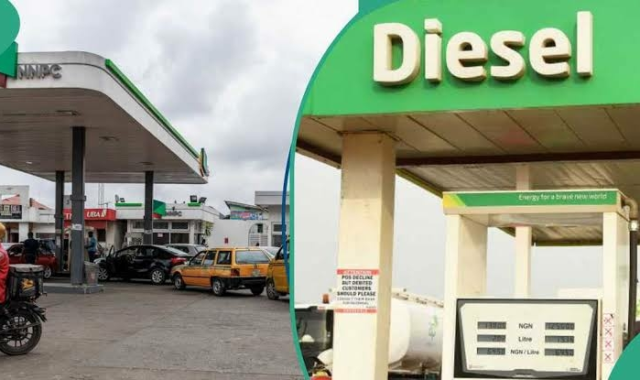

Finance Minister and Coordinating Minister of the Economy Taiwo Oyedele announced at a press conference in Abuja on Thursday 8 October 2026 that petrol sold by Nigerian National Petroleum Company Limited (NNPC) will carry a discount for 30 days. Nairametrics quotes him as saying the discount applies "in the first instance", with priority for public transporters nationwide. Daily Trust reports the same priority for public transporters.
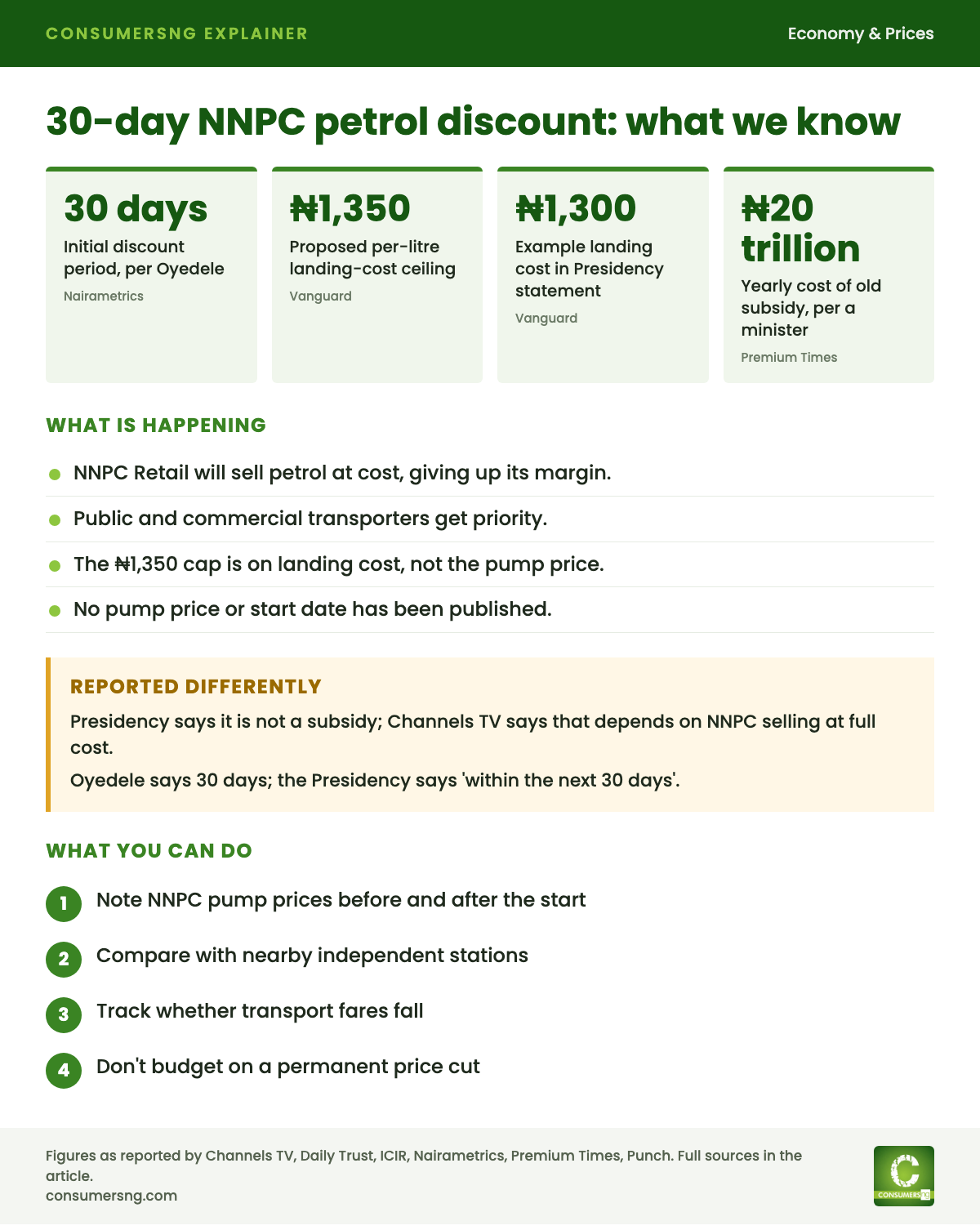
Oyedele said this is not a subsidy because government is simply asking NNPC to sell at cost, according to Nairametrics. In practice, NNPC Retail gives up its usual profit margin on petrol and charges what the fuel cost it to land. For a reader, that means any saving would show up only at NNPC-run stations, and no source has yet stated a pump price or a naira-per-litre reduction.
Vanguard and ThisDay both report a statement from Bayo Onanuga, Special Adviser to the President on Information and Strategy, which says President Bola Tinubu approved the measure. The statement gives an example: if NNPC's landing cost is ₦1,300 a litre, it would sell to Nigerians, especially commercial vehicle operators, at that same price. That ₦1,300 is an illustration, not a confirmed pump price.
The statement also says the government is negotiating a ceiling of ₦1,350 a litre on the ex-gantry or landing cost of petrol. Ex-gantry or landing cost is the price of the fuel at the depot or on arrival, before transport and the station owner's margin are added, so it is not the price at the pump. According to Vanguard, refiners and importers would carry any shortfall when costs rise above the ceiling and recover it later when crude prices or the exchange rate allow. The ceiling is to be reviewed monthly, with figures published.
The Presidency statement says the arrangement is "neither a subsidy nor a price control" and that the subsidy ended on 29 May 2023, as reported by Vanguard and ThisDay. It also lists wider measures: forward sales of crude to domestic refineries, lower road taxes and levies under the 2025 tax reform laws, more funding for cash transfers and subsidised credit, and faster rollout of compressed natural gas (CNG) vehicles. It adds a possible tax on excess profits and price-gouging, tax relief for low earners under the 2027 Finance Bill, and a National Strategic Fuel Reserve.
Opposition figures including Atiku Abubakar have rejected the plan, Punch reports, calling the NNPC-led intervention inadequate and politically motivated. Channels TV's analysis asks the questions many readers will have: how much cheaper petrol will be, who benefits, whether fares will fall and what happens after 30 days.
What the sources say
- Vanguard: Reports a Presidency statement by Bayo Onanuga saying NNPC Retail will forgo its profit margin, that Tinubu approved the plan, and that a ₦1,350 a litre ceiling on landing cost is being negotiated and will be reviewed monthly.
- ThisDay: Reports the same Presidency statement, says the FG expects transporters to pass savings to passengers through lower fares, and describes the ceiling as one the FG is negotiating.
- Daily Trust: Quotes Finance Minister Taiwo Oyedele on a discount on NNPC petrol for the next 30 days with priority for public transporters, and a negotiated landing cost reviewed monthly. No price figures given.
- Nairametrics: Quotes Oyedele saying the discount runs for 30 days in the first instance, is not a subsidy, and means government is asking NNPC to sell at cost.
- Channels TV: Editorial analysis arguing that Nigeria's cost-of-living crisis is not a 30-day problem, that prioritising public transport is sensible, and that the plan is more manageable than the old subsidy only if NNPC is genuinely cutting its margin rather than selling below full cost.
- ICIR: Reports Oyedele's press briefing and describes the ₦1,350 a litre ceiling on ex-gantry or landing cost as proposed, alongside the 30-day NNPC discount.
- Premium Times: Reports that the FG rejected calls to restore petrol subsidy, with a minister saying pre-reform pricing would cost more than ₦20 trillion a year and could push the exchange rate towards ₦3,000 to a dollar and petrol to at least ₦2,000 a litre.
- Punch: Reports that opposition figures including Atiku Abubakar reject the discount, calling the NNPC-led intervention inadequate and politically motivated.
Where the sources agree
- Oyedele announced the 30-day NNPC petrol discount at a press briefing in Abuja on 8 October 2026, and the Presidency's Onanuga statement repeats it (Daily Trust, Nairametrics, International Centre for Investigative Reporting (ICIR), Vanguard, ThisDay).
- The discount covers petrol sold by NNPC, with priority for public or commercial transport operators (Daily Trust, Nairametrics, Vanguard, ThisDay, Channels TV).
- The government says it is not a subsidy because NNPC sells at cost and gives up its retail margin, and says it is not reversing the end of the subsidy (Nairametrics, Vanguard, ThisDay).
- A ₦1,350 a litre ceiling on ex-gantry or landing cost is being proposed or negotiated and will be reviewed monthly (Vanguard, ThisDay, ICIR, Daily Trust).
- Duration and what happens after the first 30 days are the central worries (Channels TV analysis).
Where they differ
When the 30 days start and how long relief lasts
- Nairametrics: Quotes Oyedele saying the discount is for the next 30 days in the first instance, which suggests it could be extended but does not commit to an extension.
- Vanguard: Quotes the Presidency statement saying NNPC Retail will offer the new deal "within the next 30 days", wording that could mean it starts at some point in that window. No start date is given.
Is the ₦1,350 ceiling agreed, and what does it cap?
- ICIR: Describes it as a proposed ceiling on ex-gantry or landing cost announced alongside the discount.
- ThisDay: Its headline says the Presidency backs NNPC Limited's target of a ₦1,350 petrol cost ceiling, while the report says the FG is still negotiating it. It does not say who is party to the talks.
Whether the discount is a subsidy in disguise
- Vanguard: Presidency statement calls the arrangement neither a subsidy nor a price control, because NNPC forgoes its margin rather than being paid by government.
- Channels TV: Its analysis says the plan is manageable only if NNPC is genuinely cutting its retail margin rather than selling below its full economic cost; if it is the latter, it would look more like a subsidy.
Purpose of the measure
- Vanguard: The Presidency says the aim is to cushion vulnerable households from global crude price shocks.
- Punch: Opposition figures including Atiku Abubakar call the measure inadequate and politically motivated. These are political positions, and no evidence has been presented on motive.
What the authorities say
Finance Minister Taiwo Oyedele said on 8 October 2026 that NNPC will sell petrol at a discount for 30 days in the first instance, with priority for public transporters, and that it is not a subsidy because NNPC is selling at cost (Nairametrics, Daily Trust). The Presidency, in a statement by Bayo Onanuga, says President Tinubu approved the measure, that the ₦1,350 a litre landing-cost ceiling is being negotiated and will be reviewed monthly with figures published, and that the subsidy ended on 29 May 2023 (Vanguard, ThisDay). Premium Times quotes a minister as saying restoring the old subsidy would cost over ₦20 trillion a year. No separate statement from NNPC Limited has been reported in these sources.
What this means for you
If the plan works as described, petrol at NNPC stations could become cheaper for an initial 30 days. No source gives a pump price or a naira reduction, so do not assume a particular saving.
Commercial and public transport operators get priority. The Presidency says it expects them to pass savings on through lower fares (ThisDay), but no mechanism to make this happen has been described. Channels TV treats lower fares as unproven, so passengers may not see quick changes.
The discount applies to NNPC-sold petrol. Sources do not say whether independent marketers will change their prices, although Vanguard reports the hope that others would follow NNPC. If you live far from an NNPC station, your price may not change.
The relief is temporary and no plan for after 30 days has been set out beyond monthly reviews of the ceiling. Because refiners and importers can recover shortfalls later when crude prices or the exchange rate allow, prices could move up again after the window.
Other measures mentioned by the Presidency, such as cash transfers, subsidised credit, CNG expansion and tax relief for low earners, are either unquantified or still under consideration, so none should be counted on yet.
What you can do
- Check the pump price at your nearest NNPC station before and after the scheme starts, and note the date, so you can see whether any reduction is real.
- Compare NNPC's price with nearby independent stations before deciding where to buy, since the discount is described only for NNPC.
- If you use commuter transport, ask drivers or unions whether fares are changing, and keep a record of fares so you can tell if savings are passed on.
- Keep receipts for fuel purchases, and report suspected overcharging or hoarding at a station to the relevant regulator or the Federal Competition and Consumer Protection Commission (FCCPC).
- Do not plan household budgets on a permanent fall in petrol prices, since the discount is for 30 days in the first instance.
ConsumersNG is a consumer research platform, not a financial adviser, lawyer or medical professional. These steps are general information to help you ask the right questions. Before making decisions about your money, health or legal rights, check with the relevant regulator or a qualified professional. Read our full Disclaimer.
Still unclear
- What will the NNPC pump price be, and by how many naira per litre will it fall? The ₦1,300 figure in the Presidency statement is only an example.
- When exactly does the discount start and end, and what decides whether it is extended after the first 30 days?
- How will operators qualify for priority, and will private motorists get the same price?
- Is the ₦1,350 ceiling agreed, who is negotiating it (refiners, importers or others), and who bears and recovers any shortfall?
- Is NNPC truly selling at full cost, and how will its finances be reported so this can be checked?
- Will independent marketers follow NNPC, and will transport fares and food prices actually fall?
- Can the ₦20 trillion annual cost of restoring subsidy, the ₦3,000 to a dollar exchange rate and the ₦2,000 a litre petrol figures be supported by independent analysis?
ConsumersNG's view
For ordinary Nigerians, this is short-term relief for some people, so be hopeful but careful. Selling petrol at cost at NNPC stations could lower prices, especially for transport operators. But no pump price, start date or end plan has been given. Until those details come out, judge the promise by what you see at the pump.
The government says this is not a subsidy. That could be true if NNPC is only giving up its own profit, but the figures to prove it have not been published. Channels TV is right that it depends on whether NNPC really sells at full cost. The opposition calls it a vote-winning move, but no source proves or disproves that. Judge it by pump prices and fares, not by the politics.
Watch three things: NNPC's actual pump price compared with the ₦1,350 price ceiling, whether bus and taxi fares really fall, and what happens when the 30 days end. Keep receipts and note the prices you pay. The Presidency has promised to publish monthly figures. Hold it to that promise.
This is ConsumersNG's opinion based on the sources above. It is not financial, legal or investment advice. Please speak to a qualified adviser before making decisions.
Sources & references
- OfficialVanguard NNPC discount measure for petrol pump price has Tinubu's backing – Presidency
- OfficialThisDay Presidency Forecloses Return Of Petrol Subsidy, Backs NNPCL's Target of N1,350 Petrol Cost Ceiling
- SupportsDaily Trust FG reveals plan to make Nigerians enjoy cheaper fuel for one month
- SupportsNairametrics FG announces 30-day discount window on fuel sold by NNPC
- ContextChannels TV Petrol Discount: Welcome Relief Or Another Short-Lived Promise?
- SupportsICIR FG proposes N1,350 petrol price ceiling, announces 30-day NNPC discount
- ContextPremium Times Fuel subsidy would cost Nigeria over N20trn yearly — Minister
- CountersPunch FG's 30-day petrol discount sparks opposition backlash
Researched with AI assistance and reviewed by a ConsumersNG editor. How we research.