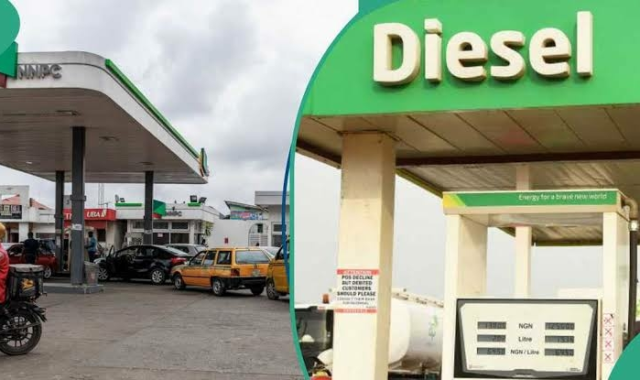

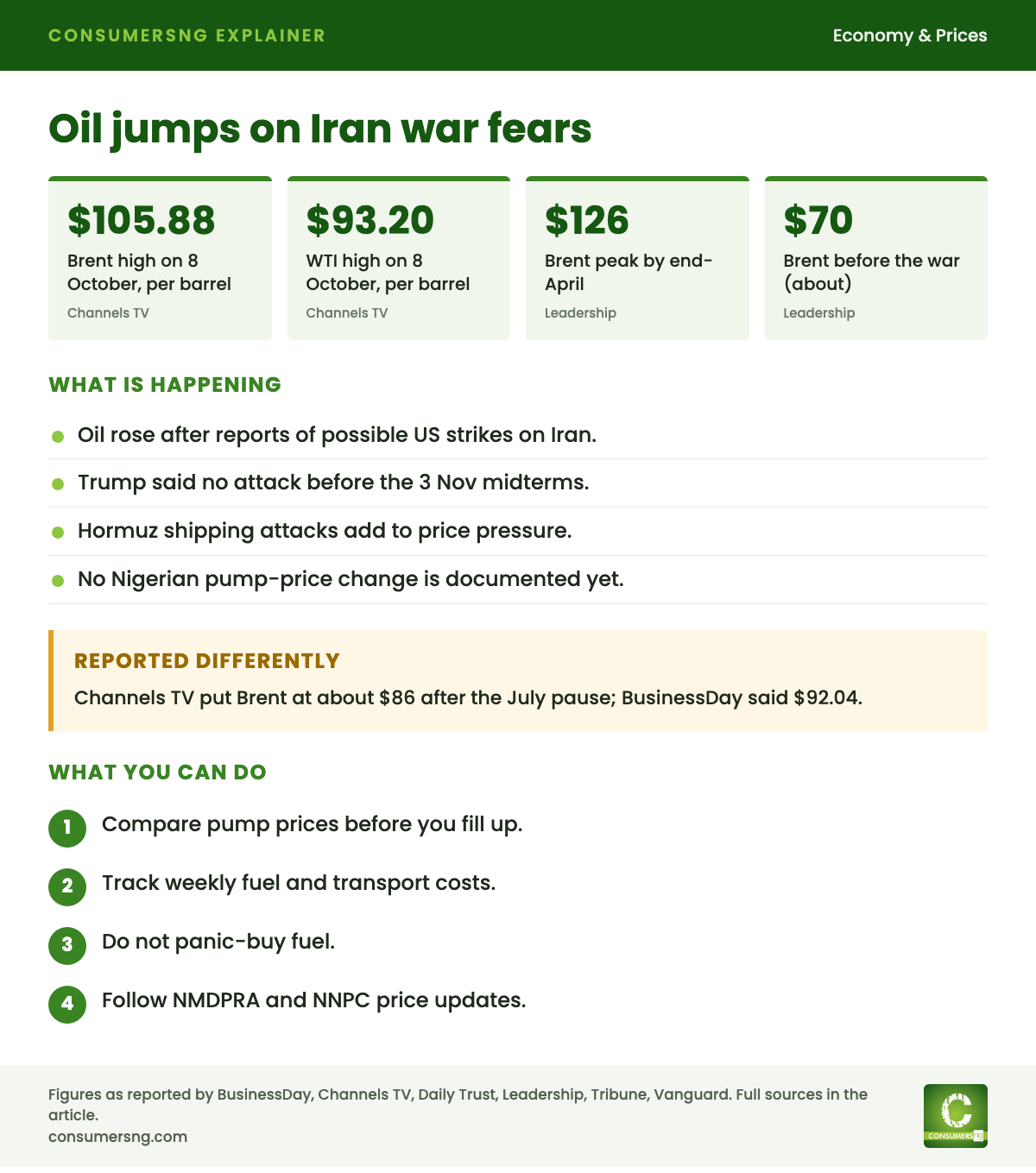
Oil prices climbed sharply on Thursday 8 October 2026. Channels TV reported that Brent crude, the international benchmark that most of the world's oil is priced against, rose as high as $105.88 a barrel before easing to $104.28. Late in the session, at about 2030 Greenwich Mean Time (GMT), it was up 4.1%. West Texas Intermediate (WTI), the main US benchmark, reached $93.20 and was reported at $91.49, up 3.6%.
The jump followed a report by The Atlantic, a US magazine, that the White House had asked the Pentagon for options to strike sites in Iran before the US midterm elections on 3 November. Vanguard reports that the New York Times carried a similar account the same day and said the plans were being developed despite President Donald Trump's "ambivalence". For readers, the point is that markets are reacting to the possibility of a wider conflict, not only to events that have already happened.
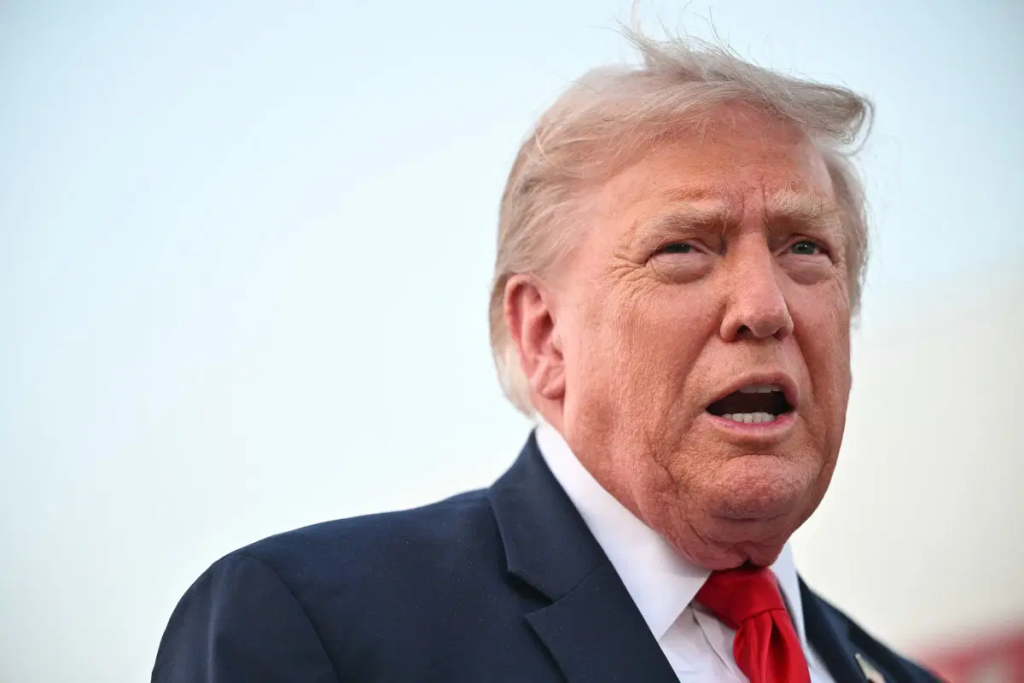
Trump then posted on his Truth Social platform that the US "will not be attacking Iran at any time prior to the Midterm Elections". Channels TV and Vanguard both quote him saying the US blockade of Iran will stay "in full force and effect" and that the two countries are holding "productive discussions". He gave no details about those talks, and neither outlet reports any Iranian confirmation.
Strike plans are not the only driver. Andy Lipow of Lipow Oil Associates told the wire report carried by Channels TV that markets are also reacting to "increased Iranian attacks on traffic through the Strait of Hormuz", the narrow sea lane through which a large share of the world's oil ships. He also named a hurricane in the Gulf of Mexico shutting in oil production as a worry. Vanguard adds that the United Kingdom Maritime Trade Operations (UKMTO) said a tanker off Qatar's north coast was hit by multiple projectiles on Wednesday, with an unspecified number of casualties, and that Yemen's Houthis and Saudi Arabia are also in conflict.
The price moves fit a pattern that runs through the war, which Vanguard says the US and Israel launched in February. Leadership reported around early August that Brent rose from about $70 before the end-February strikes to a peak of $126 by the end of April, then eased to about $85.
Daily Trust reported around 1 October that Brent rose 2.8% to $107.26 after reports that Trump rejected Iran's latest proposal to reopen the Strait of Hormuz. In July, Channels TV and BusinessDay both reported that Brent fell about 5% to 6% when the US and Iran paused strikes. Prices tend to fall on talk of talks and rise on escalation.
None of the coverage cited here ties this week's price rise directly to Nigerian pump prices, the naira or the cost of living. What it does show is crude oil trading about $35 above the roughly $70 it sold for before the war, according to Leadership. Any effect on what Nigerians pay for petrol, diesel or transport would depend on how local suppliers respond, and that has not been reported in these pieces.
What the sources say
- Channels TV: Reported on 8 October that Brent hit $105.88 and WTI $93.20 after The Atlantic said the White House asked the Pentagon for pre-midterm strike options. It also quotes Trump's denial and analysts on Hormuz attacks, inflation fears and bond yields.
- Vanguard: Reported on 8 October that Trump ruled out an attack before the midterms, said the blockade stays and cited "productive discussions". It adds the New York Times corroboration, the UKMTO tanker incident and Houthi-Saudi hostilities.
- Tribune Online: Reported on 10 September that Trump predicted the war would end "immediately after the election" and said Iran was trying to influence the November vote. It describes a conflict in its seventh month, with attacks on tankers and shipping.
- Leadership: Reported around early August that Brent went from about $70 before the war to a $126 peak by end-April, then about $85. ExxonMobil and Chevron made combined profits above $26bn in the three months to June, and Trump demanded they cut retail prices.
- Daily Trust: Reported around 1 October that Brent rose 2.8% to $107.26 and WTI 1.8% to $94.07 after reports that Trump rejected Iran's latest proposal to reopen the Strait of Hormuz.
- Channels TV: Reported on 27 July that oil slumped when the US and Iran paused strikes, with Brent at about $86 after falling about 5% to 6%. It noted Brent had topped $100 for the first time since May after hostilities resumed in July.
- BusinessDay: Reported on 27 July that Brent dropped about 5% to $92.04 in early Asian trading after the US and Iran halted attacks.
Where the sources agree
- Channels TV and Vanguard agree on the sequence: reports of possible US strikes before the midterms, an oil price spike on Thursday 8 October, then Trump's Truth Social denial citing "productive discussions".
- Both name The Atlantic as the origin of the strike-options report.
- Both treat tension around the Strait of Hormuz as an added driver of higher prices.
- Both say fuel prices are a political problem for Trump at home, with Vanguard citing polls showing voters strongly dissatisfied.
- Channels TV, Daily Trust, Leadership and BusinessDay all describe prices that fall on pauses or signals of talks and rise on escalation, with Brent moving in a broad range of roughly $85 to $107 since summer.
Where they differ
How far Brent fell after the US-Iran pause on 27 July
- Channels TV: Put Brent at about $86 after a drop of roughly 5% to 6%.
- BusinessDay: Put Brent at $92.04 in early Asian trading, after a drop of about 5%.
What is driving the 8 October spike
- Channels TV: Points to the strike reports and, citing analyst Andy Lipow, Iranian attacks on Hormuz shipping, plus a hurricane in the Gulf of Mexico. It also cites inflation and bond-yield worries.
- Vanguard: Stresses the strike reports and New York Times corroboration, and adds Houthi-Saudi hostilities and the UKMTO tanker incident off Qatar.
What the authorities say
The only official position in the coverage is Trump's. In a Truth Social post on 8 October, quoted by Channels TV and Vanguard, he said the US will not attack Iran before the midterm elections, that the blockade stays in force and that "productive discussions" are under way with Iran, without giving details. He also said Iran is "in very bad condition", according to Vanguard. UKMTO reported the tanker strike off Qatar. The coverage cited carries no statement from Iran, the Pentagon, the Nigerian National Petroleum Company Limited (NNPC), the Nigerian Midstream and Downstream Petroleum Regulatory Authority (NMDPRA), the Central Bank of Nigeria (CBN) or the Nigerian government on this episode.
What this means for you
Nigerians buy petrol and diesel at prices that follow world oil trends, so a Brent price near $104 against about $70 before the war, as Leadership reported, is a warning sign for pump prices. None of the coverage cited documents a Nigerian pump-price change from this week's spike, so treat any link as a risk to watch, not a confirmed increase.
Higher oil can feed inflation. Forex.com analyst Fawad Razaqzada told the wire report carried by Channels TV that more expensive oil is intensifying inflation concerns and pushing up bond yields, which are the returns investors demand to lend to governments. That is a global-market comment, not a Nigeria-specific one, but households already stretched by food and transport costs should plan for volatility.
Prices swing fast on political statements. Brent fell about 5% to 6% on a pause in July, per Channels TV and BusinessDay, then climbed again. Any pump-price move based on a single day's spike may not last, and a later fall may not reach stations quickly.
What you can do
- Check official or widely reported pump prices before filling up, and compare nearby stations rather than assuming one price applies everywhere.
- Keep a simple record of what you pay for fuel and transport each week so you can see real changes in your costs.
- Do not panic-buy or hoard fuel on rumours. Daily swings in crude do not always reach pump prices.
- Watch for announcements from NMDPRA and NNPC on pump prices, and be wary of unverified messages about price changes on social media.
- If you run a small business that depends on diesel or transport, build a small buffer into your pricing and budget for a range of fuel costs.
ConsumersNG is a consumer research platform, not a financial adviser, lawyer or medical professional. These steps are general information to help you ask the right questions. Before making decisions about your money, health or legal rights, check with the relevant regulator or a qualified professional. Read our full Disclaimer.
Still unclear
- Will the US and Iran hold talks, and what is in them? Trump gave no detail on the "productive discussions" and the coverage cited carries no Iranian confirmation.
- What happens after the 3 November midterms? Trump's pledge covers only the period before the vote, and Tribune reported in September he expects the war to end after it.
- Will Nigerian pump prices follow the rise in Brent, and how quickly? No Nigerian price data, NNPC or NMDPRA comment appears in the coverage cited.
- How will Nigeria's crude revenue and budget be affected by oil near $100 or more? The coverage cited does not address it.
- Will the Strait of Hormuz attacks and tanker incidents widen, and will crude return to pre-war levels only if the crisis ends fully?
ConsumersNG's view
Oil prices are now moving as much on what politicians say as on how much oil is available. Brent crude, the world's main oil price, has swung between about $85 and $107 a barrel since mid-year. So treat one day's jump as a warning, not a sign of what you will pay.
Donald Trump's denial does not really contradict the reports by The Atlantic and The New York Times. His promise only covers the period before 3 November, and he gave no details of the talks. Meanwhile, attacks around the Strait of Hormuz and a tanker incident, reported by Vanguard and Channels TV, are real threats to supply. It is too early to say the danger has passed.
What matters for you is whether this rise reaches Nigerian pump prices, and how fast. Suppliers and regulators should be open about prices. Compare prices before you buy fuel instead of paying the first price you are given. And leave some room in your budget for transport and fuel while the conflict lasts.
This is ConsumersNG's opinion based on the sources above. It is not financial, legal or investment advice. Please speak to a qualified adviser before making decisions.
Sources & references
- SupportsChannels TV Oil Surges, Stocks Sink On Jitters Over US Plans In Iran War
- SupportsVanguard Trump rules out new Iran attack before US midterm elections
- ContextTribune Trump says Iran war will end after US midterm elections
- ContextLeadership Oil Companies Are Making Too Much Money From Iran War — Trump
- ContextDaily Trust Oil prices rise after Trump rejected Iran proposal
- ContextChannels TV Oil prices slump as US and Iran pause strikes
- ContextBusinessDay Oil prices drop 5% as US, Iran halt attacks
Researched with AI assistance and reviewed by a ConsumersNG editor. How we research.